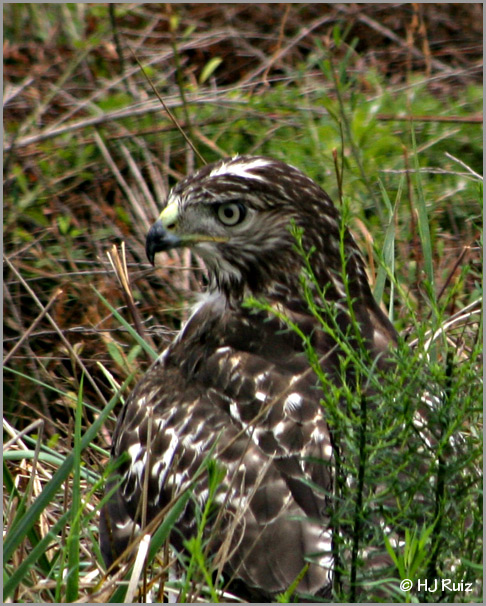
Cooper's Hawk - Spec. Name:
Accipiter Cooperii
This is a medium-sized
hawk native to the
North American continent and found from
Canada to
Mexico. As in many birds of prey, the male is smaller than the female. The birds found east of the
Mississippi River tend to be larger on average than the birds found to the west.
Cooper's Hawk was first described by French naturalist
Charles Lucien Bonaparte in 1828. It is a member of the goshawk genus
Accipiter. This bird was named after the naturalist
William Cooper, one of the founders of the New York Lyceum of Natural History (later the
New York Academy of Sciences) in
New York. Other common names; Big Blue Darter, Chicken Hawk, Hen Hawk, Mexican Hawk, Quail Hawk, Striker and Swift Hawk.

The average size of an adult male ranges from 280 to 350 g with a length between 35 and 46 cm. The adult male is significantly smaller than the average female, which are 440 to 570 g and 42 to 50 cm long. Individuals living in the eastern regions tend to be larger and heavier than those in the western regions. All have short rounded wings and a very long tail with dark bands, round-ended at the tip. Adults have red eyes and have a black cap, with blue-gray upper parts and white underparts with fine, thin, reddish bars. Their tail is blue gray on top and pale underneath, barred with black bands. Immatures have yellow eyes and have a brown cap, with brown upper parts and pale underparts with thin black streaks mostly ending at the belly. Their tail is brown on top and pale underneath, barred with dark bands. The eyes of this hawk, as in most predatory birds, face forward, enabling good depth perception for hunting and catching prey while flying at top speeds. They have hooked bills that are well adapted for tearing flesh of prey. Immatures are somewhat larger than a Sharp-shinned Hawk and smaller than a
Northern Goshawk, though small males nearly overlap with large female
Sharp-shinned Hawks, and large female Cooper's Hawks nearly overlap with small male Goshawks. The Cooper's Hawk appears long-necked in flight and has been described by birdwatchers as looking like a "flying cross". The Cooper’s Hawk is seen mostly flying with quick, consecutive wing beats and a short glide, though they may also soar. Distribution and habitat Their breeding range extends from southern
Canada to northern
Mexico. They are generally distributed more to the south than the other North American
Accipiters, the
Sharp-shinned Hawk and the
Northern Goshawk. Birds from most of the Canadian and northern-
U.S.-range
migrate in winter, and some Cooper's Hawks winter as far south as
Panama). The Cooper’s Hawk occur in various types of mixed
deciduous forests and open woodlands, including small woodlots,
riparian woodlands in dry country, open and
pinyon woodlands, and forested mountainous regions and also now nests in many cities. They were once thought to be adverse to cities and towns, but are now fairly common urban and suburban birds. The cities provide plenty
Rock Pigeon and
Mourning Dove for the Cooper’s Hawk to prey on.
These birds capture prey from cover or while flying quickly through dense vegetation, relying almost totally on surprise. One study showed that this is a quite dangerous hunting style. More than 300 Cooper’s Hawk skeletons were investigated and 23% revealed healed fractures in the bones of the chest. Most prey are mid-sized birds, with typical prey including
American Robins,
jays,
woodpeckers,
European Starlings,quail,
icterids and
doves. Birds preyed on can range in size from
wood-warblers to
Ring-necked Pheasants. They may also prey upon the raptor
American Kestrel. They have been known to rob nests and also eat small
mammals like
chipmunks,
hares,
mice,
squirrels, and
bats. Other possibilities are
lizards,
frogs,
snakes and large
insects. It normally catches its prey with its feet and kills it by repeatedly squeezing it and holding it away from its body until it dies. They have also been seen drowning their prey, holding it underwater until it stops moving. The hawks, in addition, often pluck the
feathers off their prey on a post or other perch. They are increasingly seen hunting smaller
songbirds in backyards with feeders. They will perch in trees overlooking the feeders, then swoop down and scatter the other birds in order to capture one in flight. These hawks can also pursue their prey on the ground by half running and half flying.
Text is available under the
Creative Commons Attribution-ShareAlike License; additional terms may apply. See
Terms of Use for details.
Wikipedia® is a registered trademark of the
Wikimedia Foundation, Inc., a non-profit organization.