Showing posts with label Carolina Chickadees. Show all posts
Saturday, June 11, 2011
Carolina Chickadee - Photo Album
Saturday, April 16, 2011
Well organized birds!
Last year I had a family of Carolina Chickadees nesting in one of my birds houses, apparently the couple had paired and lay eggs to have family, after a while the eggs had hatched and they had some chicks, in time they grew strong enough to fly, then the whole family of Carolina Chickadees flew away at the end of the season.
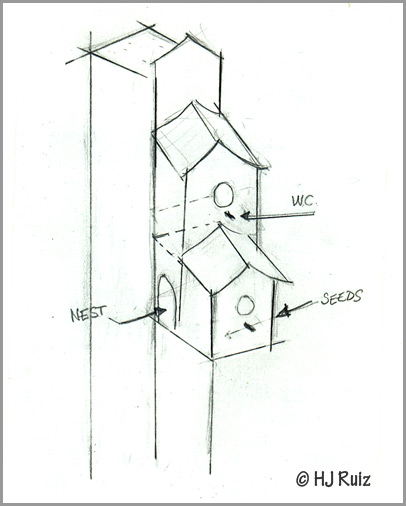
I then opened the small door to see the inside of the house and I was truly surprised to find how well organized these birds were while they lived there.
I’ve made a small diagram to explain to you what I found. In the bottom compartment was an elaborated nest made of twigs and what appear to be peat moss. In the compartment above the nest was used as a WC (Bathroom). In the anteroom connected to the abode was a bunch of different seeds, it was obvious that it was the place were they ate. I couldn’t believe how well the Chickadees organized their home. Just like humans would do. I think that it is very remarkable and gave me great satisfaction to have found these facts by my own observations.
![]() |
| Carolina Chickadee |
I then opened the small door to see the inside of the house and I was truly surprised to find how well organized these birds were while they lived there.
I’ve made a small diagram to explain to you what I found. In the bottom compartment was an elaborated nest made of twigs and what appear to be peat moss. In the compartment above the nest was used as a WC (Bathroom). In the anteroom connected to the abode was a bunch of different seeds, it was obvious that it was the place were they ate. I couldn’t believe how well the Chickadees organized their home. Just like humans would do. I think that it is very remarkable and gave me great satisfaction to have found these facts by my own observations.
Thursday, April 14, 2011
Carolina Chickadee
Carolina Chickadee- Spec. Name: Poecile Carolinensis
This is a small passerine bird in the tit family Paridae. Often, it is still placed in the genus Parus with most other tits, but mtDNA cytochrome b sequence data and morphology suggest that separating Poecile more adequately expresses these birds' relationships (Gill et al., 2005). The American Ornithologists' Union has been treating Poecile as distinct genus for some time already.
Adults are 11.5–13 cm long with a weight of 9–12 g, and have a black cap and bib with white sides to the face. Their underparts are white with rusty brown on the flanks; their back is grey. They have a short dark bill, short wings and a moderately long tail. Very similar to the Black-capped Chickadee, the Carolina Chickadee is best told from it by the slightly browner wing with the greater coverts brown (not whitish fringed) and the white fringing on the secondary feathers slightly less conspicuous; the tail is also slightly shorter and more square-ended. The calls and song also differ subtly to an experienced ear: the Carolina Chickadee's chick-a-dee call is faster and higher pitched than that of the Black-Capped Chickadee, and the Carolina chickadee has a four note fee-bee-fee-bay song, whereas the Black-capped omits the high notes. Identification is very difficult even with an excellent view.
The most famous call is the familiar chick-a-dee-dee-dee which gave this bird its name and its song is fee-bee-fee-bay.
Their breeding habitat is mixed or deciduous woods in the United States from New Jersey west to southern Kansas and south to Florida and Texas; there is a gap in the range at high altitudes in the Appalachian Mountains where they are replaced by their otherwise more northern relative, the Black-capped Chickadee. They nest in a hole in a tree; the pair excavates the nest, using a natural cavity or sometimes an old woodpecker nest. They may interbreed with Black-capped Chickadees where the ranges overlap, which can make identification difficult.
They are permanent residents, not usually moving south even in severe winter weather.
These birds hop along tree branches searching for food, sometimes hanging upside down or hovering; they may make short flights to catch insects in the air. Insects form a large part of their diet, especially in summer; seeds and berries become important in winter. They sometimes hammer seeds on a tree or shrub to open them; they also will store seeds for later use.
During the fall migration and winter, chickadees often flock together. Many other species of birds, including titmice, nuthatches, and warblers can often be found foraging in these flocks. Mixed flocks stay together because the chickadees call out whenever they find a good source of food. This calling out forms cohesion for the group, allowing the other birds to find food more efficiently.
Carolina chickadees are able to lower their body temperatures to induce an intentional state of hypothermia called torpor. They do this to conserve energy during extremely cold winters. In extremely cold weather conditions they look for cavities where they can hide in and spend up to fifteen hours at a time in torpor; during this time they are awake but unresponsive; they should not be picked up and handled at this time, as the stress of being held may cause their death.
Carolina chickadees are so similar to black-capped chickadees that they themselves have trouble telling their species apart. Because of this they sometimes mate producing hybrids. The most obvious difference between the three chickadees is that the Carolina chickadee sings four-note song, black-capped ones sing two-note songs, and the hybrids sing three-note songs.
All photographs shown in this blog were shot by HJ Ruiz.
Text is available under the Creative Commons Attribution-ShareAlike License; additional terms may apply. See Terms of Use for details.
Wikipedia® is a registered trademark of the Wikimedia Foundation, Inc., a non-profit organization.
This is a small passerine bird in the tit family Paridae. Often, it is still placed in the genus Parus with most other tits, but mtDNA cytochrome b sequence data and morphology suggest that separating Poecile more adequately expresses these birds' relationships (Gill et al., 2005). The American Ornithologists' Union has been treating Poecile as distinct genus for some time already.
![]() |
| Carolina Chickadee |
Adults are 11.5–13 cm long with a weight of 9–12 g, and have a black cap and bib with white sides to the face. Their underparts are white with rusty brown on the flanks; their back is grey. They have a short dark bill, short wings and a moderately long tail. Very similar to the Black-capped Chickadee, the Carolina Chickadee is best told from it by the slightly browner wing with the greater coverts brown (not whitish fringed) and the white fringing on the secondary feathers slightly less conspicuous; the tail is also slightly shorter and more square-ended. The calls and song also differ subtly to an experienced ear: the Carolina Chickadee's chick-a-dee call is faster and higher pitched than that of the Black-Capped Chickadee, and the Carolina chickadee has a four note fee-bee-fee-bay song, whereas the Black-capped omits the high notes. Identification is very difficult even with an excellent view.
The most famous call is the familiar chick-a-dee-dee-dee which gave this bird its name and its song is fee-bee-fee-bay.
Their breeding habitat is mixed or deciduous woods in the United States from New Jersey west to southern Kansas and south to Florida and Texas; there is a gap in the range at high altitudes in the Appalachian Mountains where they are replaced by their otherwise more northern relative, the Black-capped Chickadee. They nest in a hole in a tree; the pair excavates the nest, using a natural cavity or sometimes an old woodpecker nest. They may interbreed with Black-capped Chickadees where the ranges overlap, which can make identification difficult.
They are permanent residents, not usually moving south even in severe winter weather.
These birds hop along tree branches searching for food, sometimes hanging upside down or hovering; they may make short flights to catch insects in the air. Insects form a large part of their diet, especially in summer; seeds and berries become important in winter. They sometimes hammer seeds on a tree or shrub to open them; they also will store seeds for later use.
During the fall migration and winter, chickadees often flock together. Many other species of birds, including titmice, nuthatches, and warblers can often be found foraging in these flocks. Mixed flocks stay together because the chickadees call out whenever they find a good source of food. This calling out forms cohesion for the group, allowing the other birds to find food more efficiently.
Carolina chickadees are able to lower their body temperatures to induce an intentional state of hypothermia called torpor. They do this to conserve energy during extremely cold winters. In extremely cold weather conditions they look for cavities where they can hide in and spend up to fifteen hours at a time in torpor; during this time they are awake but unresponsive; they should not be picked up and handled at this time, as the stress of being held may cause their death.
Carolina chickadees are so similar to black-capped chickadees that they themselves have trouble telling their species apart. Because of this they sometimes mate producing hybrids. The most obvious difference between the three chickadees is that the Carolina chickadee sings four-note song, black-capped ones sing two-note songs, and the hybrids sing three-note songs.
All photographs shown in this blog were shot by HJ Ruiz.
Text is available under the Creative Commons Attribution-ShareAlike License; additional terms may apply. See Terms of Use for details.
Wikipedia® is a registered trademark of the Wikimedia Foundation, Inc., a non-profit organization.
Subscribe to:
Posts (Atom)